


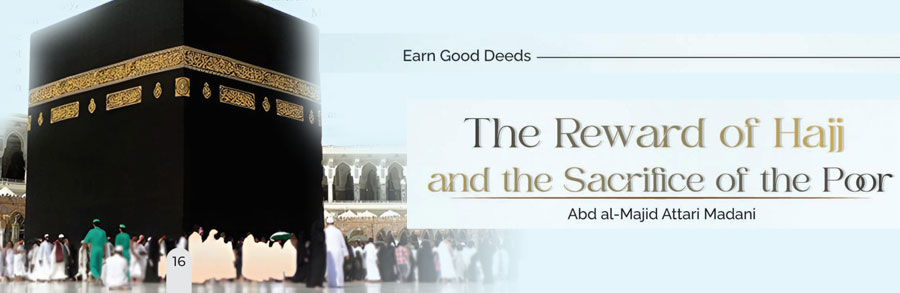
The Reward of Hajj and the Sacrifice of the Poor
In the blessed Hadith, many good deeds are mentioned through which immense reward can be earned easily. Some of these simple deeds are as follows:
Perform the Dhikr of Allah Almighty Abundantly
The beloved Prophet صَلَّى الـلّٰـهُ عَلَيْهِ وَاٰلِهٖ وَسَلَّم said:
In the court of Allah, there are no days more virtuous and beloved than these ten days of Hajj; therefore, recite لَآ اِلٰہَ اِلَّا اللہ، اَللہ اَکْبَرُ and engage in the dhikr of Allah in abundance during these days. Fasting for one day during these days is equivalent to fasting for a whole year, and the reward for good deeds performed in these days is multiplied seven hundredfold.[1]
The Poor Can Also Earn the Reward of a Sacrifice
Sacrifice (Qurbānī) is compulsory (واجب) upon those who possess the means to do so, and the virtues of performing a sacrifice have been mentioned in the blessed Aḥādīth extensively. A poor person who does not have the ability to perform a sacrifice should not be disheartened, as he too can earn its reward. Accordingly, Mufti Aḥmad Yār Khān NaꜤīmī رَحْمَةُ الـلّٰـهِ عَـلَيْه states: “Whoever cannot perform the sacrifice should also refrain from having a haircut during this ten-day period (from the 1st to the 10th of Dhū al-Ḥijjah). If he has a haircut on the day of Eid al-Aḍḥā after the Eid prayer, he will obtain the reward (of the sacrifice), اِنْ شَــآءَالـلّٰـه.”[2]
Important Clarification
It is necessary to trim the nails and remove the underarm hair and the hair below the navel within forty days. Delaying this beyond forty days is a sin. Therefore, if a person has not trimmed their nails for thirty-one days and the moon for Dhū al-Ḥijjah is sighted, they cannot wait until the 10th of Dhū al-Ḥijjah, because on the 10th of Dhū al-Ḥijjah, it will be the forty-first day. Such a person should not attempt to attain the aforementioned excellence; rather, they should remove their pubic and underarm hair before the 10th of Dhū al-Ḥijjah so that they do not fall into sin.[3]
The Most Beloved Deed after the Obligatory Duties
It is stated in a blessed Hadith: “After the obligatory (فرائض) acts, the most beloved deed to Allah is to bring happiness to a Muslim’s heart.”[4] Therefore, do not forget poor Muslims on the joyous occasion of Eid. Perform an easy act of kindness that brings joy to their hearts by sending them the meat of the sacrifice, and strive to seek the pleasure of Allah Almighty.
Earn the Reward of Hajj
Although Hajj is obligatory (فرض) only once in a lifetime for a capable Muslim, provided other conditions are met, many pious deeds mentioned in the blessed Hadith allow one to earn the reward of Umrah or Hajj. For example:
1. The one who looks at their parents with a merciful gaze earns the reward of an accepted Hajj.[5]
2. Similarly, visiting the graves of one’s parents with the intention of seeking reward is equivalent to the reward of an accepted Hajj.[6]
3. Whoever prays Fajr in congregation and engages in the dhikr of Allah Almighty until sunrise, and then performs two units of prayer (Ishrāq), receives the reward of a Hajj and Umrah.[7]
May Allah Almighty grant us the ability to perform pious deeds.
اٰمِیْنْ بِجَاہِ خاتَمِ النَّبِیّٖن صلَّی اللہُ عَلَیْہ ِوَاٰلِہٖ وَسَلَّمَ
[1] ShuꜤab al-Īmān, vol. 3, p. 356, Hadith 3758
[2] Mirˈāt al-Manājīḥ, vol. 2, p. 370, with minor amendments
[3] Extracted from al-Fatāwā al-Riḍawiyyah, vol. 20, pp. 253-254
[4] Al-MuꜤjam al-Kabīr, vol. 11, p. 59, Hadith 11079
[5] ShuꜤab al-Īmān, vol. 6, p. 186, Hadith 7856, summarised
[6] Nawādir al-Uṣūl, vol. 1, p. 73, Hadith 98, summarised
[7] Tirmidhī, vol. 2, p. 100, Hadith 586

Comments