




How Much Fitrana Must Be Paid Per Person in Islam?
Fitrana (Sadaqat al-Fitr) is 2.05 kilograms (2 kilograms and 50 grams) of wheat or wheat flour, or the equivalent value of other prescribed staple foods, per person. It is payable on behalf of every eligible member of the household, including minor children. If paying in cash, the amount should be based on the current market value of the prescribed quantity of the chosen staple food.
Pay Fitrana 2026
There are multiple terms that are generally used in the context of fitrana, for example, zakat al-fitrah, sadqa e fitr, etc. Fitrah, or fitrana, is an Islamic term that is used for a form an obligatory charity in Islam. Fitrah is not the same as zakat. The two are quite different. While zakat is not an obligation on all Muslims (unless they have the necessary threshold of wealth).
What’s the Fitrana Amount 2026?
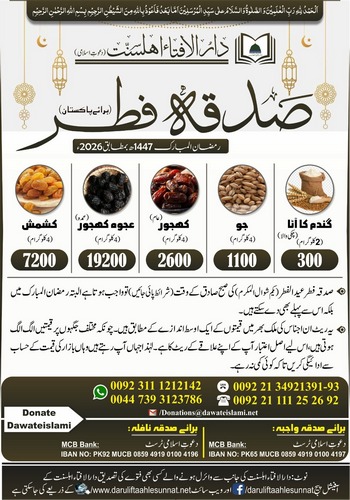
The Fitrana rate 2026 will be different from what it was last year. That’s because the rates of fitra are usually calculated on the value of dates, raisins, or wheat, and the amount is a must to pay for those Muslims who are eligible to pay it whether you Pay fitra online or hand it in person.
So, according to the Fitra calculator 2026 and the expert opinion of DawateIslami scholars, the amount for wheat flour comes out to 240 rupees per person.
Similarly, the fitra rate 2026 based on barley (jau) will be 700 rupees, dates (khajoor) 2400 rupees, raisins (kishmish) 6000 rupees and ajwa dates will be 19000 rupees.
With online fitra donation to DawateIslami you will not only be honoring the obligation of Zakat al-Fitr which is wajib for every Muslim, but also be helping provide a nutritious meal to someone that is famished and needs food to survive another day.
DawateIslami is a non-profit organization that works for the best interests of Muslims around the globe. If you donate fitra 2026 to DawateIslami, it will mean your funds will transparently reach the people that need them the most.
So, along with the importance of fitra as per Islam, we are going to discuss the sharia criteria and fitrana list 2026 below!
What Is Fitrana or Zakat al-Fitrah?
The charity given before the performance of the Eid prayer after Ramadan is called Zakat al-Fitr, which is obligatory.
The Zakat al-Fitr is essentially charity during the blessed days of Ramadan so that purification from idle and indecent activities is achieved during fasting, along with providing for the needs of the poor and destitute on the occasion of Eid, and also expressing gratitude for the blessings obtained through fasting.
Fitrah or Sadqa e Fitr – a Blessing for Muslims!
Moving on, paying Fitrana is considered a religious obligation in Islam. It’s expressing gratitude for the blessings received during Ramadan. It is also a way to foster a sense of community and solidarity among Muslims by ensuring that everyone can participate in the joyous celebration of Eid.
Having said that, paying Sadqa e Fitr 2026 will also mean your well-being. Being an important aspect of Ramadan and Eid al Fitr, Fitrah brings in multitudes of blessings for Muslims who donate – both in this life and the life after death.
Quranic Verses On Charity
Surah Al-Baqarah gives an insight into the kind act of helping those in need:
“Those who spend their wealth [in Allah’s way] by night and by day, secretly and publicly – they will have their reward with their Lord. And no fear will there be concerning them, nor will they grieve.” (Surah Al-Baqarah 2:274)
Hadees On Sadqa e Fitr
The wisdom of making Sadaqa-tul-Fitr Wajib:
Sayyiduna Ibn ‘Abbas رضی اللہ تعالٰی عنہ has narrated that the Beloved Rasool ﷺ declared Sadaqa-tul-Fitr to be Wajib for purifying the Siyam [fasts] from useless and immodest talk, and for feeding the Miskeen [needy people]. (Sunan Abi Dawood, Kitab-uz-Zakah, vol. 2, pp. 157, Hadees 1609)
In Sahih Bukhari, Sayyiduna ‘Abdullah Bin ‘Umar رضی اللہ تعالٰی عنہ narrated that the beloved Rasool ﷺ has declared Sadaqa-tulFitr to be Wajib on Muslims. (Sahih Bukhari, Kitab-uz-Zakah, vol. 1, pp. 507, Hadees 1503; summarized)
The above directly hadees refers to Zakat al-Fitrah, informing how important it is. P.S. if you need to know the amount, you could use a fitrana calculator 2026.
When Do We Need to Pay Fitrana 2026?
The right time to donate fitrana 2026 is before the month of Ramadan ends. That means you must pay your fitrana before the Eid al Fitr.
The fitrana amount 2026 will mean availability for someone that has been hungry for days. For those who may be struggling financially, Fitrana can provide much-needed relief, especially during a time when expenses may increase due to Eid celebrations.
It also helps alleviate the financial burden on individuals and families, allowing them to enjoy the holiday without worrying about their basic needs.
In addition to that, Fitra is considered a way to purify one's fasts. It is obligatory on every Muslim who possesses the minimum amount of wealth (nisab) to give Fitrana. This act of giving helps cleanse one's wealth and purify it from any undue excess or hoarding.
How To Pay Your Fitra Amount 2026?
The thing is that the amount of Zakat al-Fitrah is determined based on the value of one saa' of food. A saa' is an ancient measurement unit used during the time of the Prophet Muhammad ﷺ, and its equivalent in modern measurements may vary depending on the region.
Generally, it is about 2 kilograms of staple food items such as wheat, barley, dates, raisins, or other local foodstuffs.
Each eligible person in the household, including dependents, must pay Zakat al-Fitr. The head of the household calculates the total amount owed by multiplying the value of one saa' by the number of eligible individuals.
The fitrana details 2026 have already been discussed above.
FAQs Regarding Zakat Al-Fitr
Multiple questions surface in the minds of those who are eligible to pay zakat al-fitr. Since it’s a compulsory donation, people need to be clear about the criteria that determine the acceptance of this virtue. Below are some of the frequently asked questions by people going for online fitra donation.
· What is the sharia rule of Fitra?
It is Wajib to give Sadaqa-tul-Fitr. (Durr-e-Mukhtar, Kitab-uz-Zakah, vol. 3, pp. 362)
In Sahih Bukhari, Sayyiduna ‘Abdullah Bin ‘Umar رضی اللہ تعالٰی عنہ narrated that the beloved Rasool ﷺ has declared Sadaqa-tulFitr to be Wajib on Muslims. (Sahih Bukhari, Kitab-uz-Zakah, vol. 1, pp. 507, Hadees 1503; summarized)
· What is meant by Fitrana per person?
On whom is Sadaqa-tul-Fitr Wajib? Sadaqa-tul-Fitr is Wajib on every free Muslim who is the owner of Nisab and his Nisab is exclusive of Haajat-e-Asliyyah (i.e. basic necessities of life). (Derived from: Durr-e-Mukhtar, Kitab-uz-Zakah, vol. 3, pp. 365)
A man who is the owner of Nisab should pay his own Sadaqa-tulFitr, Sadaqa-tul-Fitr of his small children and if he has a Majnoon [insane] child, he should pay his Sadaqa-tul-Fitr as well (even if that child is Baaligh). However, if his small or insane child is himself the owner of Nisab, he may pay Fitrah from that child’s wealth. (Al-Fatawa Al-Hindiyyah, Kitab-uz-Zakah, vol. 1, pp. 192)
· How much is to be paid as Fitrana in Islam?
Basically, fitrah is equivalent to 2 kilo grams of wheat, flour, or other specific food stuff per person of the household, inclusive of all the dependents, even if they aren’t living in the same place. So, to donate fitrah online you can simply calculate the Fitrana Amount 2026 Pakistan.
Frequently Asked Questions
Faqs
Find Answers to the Most Commonly Asked Questions Related to this Page
Still have questions?
Contact Us.What is Fitrana (Zakat al-Fitr) and who must pay it?
Fitrana — also called Zakat al-Fitr, Sadqa-e-Fitr, or Fitra — is an obligatory charity paid before the Eid ul Fitr prayer. It is Wajib (obligatory) on every Muslim who is sane, has reached puberty, and possesses sufficient food and money beyond their basic needs on Eid day. Unlike Zakat on wealth, Fitrana is not based on Nisab of gold or silver — it is based on having surplus food/wealth. It must be paid on behalf of oneself and all dependants.
What is the Fitrana amount for 2026?
According to Dawat-e-Islami scholars, the Fitrana rates for 2026 are calculated based on the value of specific food items per person: wheat flour — 240 rupees; barley (jau) — 700 rupees; dates (khajoor) — 2,400 rupees; raisins (kishmish) — 6,000 rupees; and Ajwa dates — 19,000 rupees. These rates are based on the current market value of each commodity. Donors may choose any of these food types as the basis for their Fitrana calculation.
What is the difference between Fitrana and Zakat?
Fitrana (Zakat al-Fitr) and Zakat are two distinct obligations. Zakat is annual, based on Nisab (gold/silver threshold), and calculated as 2.5% of qualifying wealth accumulated over a full year. Fitrana is specifically linked to Ramadan and Eid — it is payable by any Muslim with surplus food/money regardless of Nisab, and at a fixed food-based rate per person. Fitrana must be paid before the Eid ul Fitr prayer; Zakat has no such specific deadline. Both are obligatory but serve different purposes.
When must Fitrana be paid and what happens if it is delayed?
Fitrana must ideally be paid before the Eid ul Fitr prayer — this is its primary purpose: ensuring that the poor can celebrate Eid with dignity and a proper meal. It becomes obligatory upon sighting the Eid moon (on the night before Eid). Paying it before the Eid prayer is strongly recommended (and in some opinions, obligatory for timeliness). If delayed until after the Eid prayer, the obligation remains and must still be fulfilled — but the Sunnah of paying it before prayer is missed.
What is the purpose of Fitrana for the poor on Eid?
The primary purpose of Fitrana is to ensure that every Muslim — including the poor — can celebrate Eid ul Fitr with joy and a proper meal. It functions as a spiritual purification for the fasting person (purifying fasts from minor lapses) and as a social welfare mechanism that guarantees the needy are not left out of Eid celebrations. The Prophet ﷺ ordained Fitrana to free the poor from the need to beg on Eid day — it is Islam's built-in guarantee of inclusive celebration.
How can I pay Fitrana online through Dawat-e-Islami in 2026?
You can pay Fitrana online through Dawat-e-Islami's dedicated Fitrana donation page at dawateislami.net. Dawat-e-Islami distributes your Fitrana to eligible poor Muslims — ensuring they receive a nutritious meal and can celebrate Eid. By donating online Fitrana through Dawat-e-Islami, you fulfill your Wajib obligation correctly while supporting a trusted Islamic welfare organization that has been serving the underprivileged with transparency and Islamic integrity for decades.
Can Fitrana be paid on behalf of children and dependants?
Yes. The head of the household is responsible for paying Fitrana on behalf of all Muslim dependants — including minor children, a wife, and any others financially dependent on them. Fitrana must be paid for each person separately. For example, a family of five requires five separate Fitrana payments — one per person at the applicable rate. This inclusive nature of Fitrana ensures the entire household — not just the earning member — is spiritually purified as Ramadan concludes and Eid begins."


