


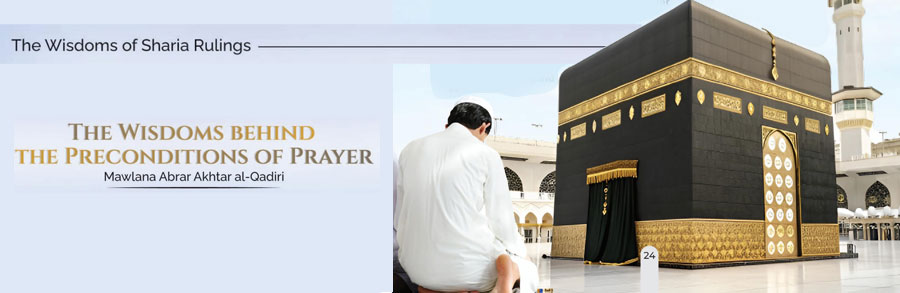
The Wisdoms behind the Preconditions of Prayer
There are six preconditions for prayer:
1.Purification.
2.Covering the private parts.
3.Facing the qibla.
4.Time.
5.Intention.
6.The opening takbīr (Takbīr al-Taḥrīm).
If one reflects on why the fulfilment of these six conditions has been made necessary before prayer, one's faith in the truth of Islam is further strengthened. Below is a brief look at the wisdom hidden within these six prerequisites:
(1) Purity
Prayer is the act of presenting oneself in the court of Allah Almighty. It is customary that before meeting any respected personality, special attention is paid to one's outward appearance and clothing, and consideration is given to where the meeting will take place. As a special favour upon the Ummah of His beloved Prophet صَلَّى الـلّٰـهُ عَلَيْهِ وَاٰلِهٖ وَسَلَّم, Allah Almighty has designated the entire earth as a place for this meeting, allowing people to appear in His court at any place of their choosing. This is why there is no fixed time or designated place for the remembrance of God, nor is any particular state or condition required for it.
However, since prayer is a special presence in the court of Allah Almighty, special preparation for it has been emphasized. Along with its prescribed times, it has also been stipulated that before presenting oneself in the divine court, one must ensure that the place of presence, i.e., where the prayer is to be performed, is clean and free from impurities and filth, and that one’s clothing is also befitting of such a meeting. Furthermore, the body itself must also be pure. This means it is essential to perform whatever form of purification is required, be it ablution (wudu), a ritual bath (ghusl), or dry ablution (tayammum).
Explaining the wisdom behind the necessity of wudu for prayer, Mufti Aḥmad Yār Khan Na’īmī رَحْمَةُ الـلّٰـهِ عَـلَيْه states that it is necessary because prayer purifies the heart. It is appropriate that the body be purified first, as this leads to outward purity. For a person with a health issue, their clothes, house, and body are kept clean to help them recover. He then explains the wisdom of washing only four limbs in wudu, stating that this is for two reasons:
First, the water of wudu removes minor faults and sins. The first misjudgement of Sayyidunā Adam عَـلَيْـهِ الـسَّـلاَم, which was eating wheat, involved these very four limbs: the thought of eating arose in the mind, the feet carried him there, the hands picked the wheat, and the mouth consumed it. Therefore, it was ordained to wash these limbs for prayer.
Second, even today, these same limbs are the primary instruments through which most sins are committed; the hands, feet, eyes, nose, ears, heart, and mind are all involved in sin. The relationship between the heart and mind is like that of a king and his minister; if the heart is distressed, it manifests outwardly through tears, and when an evil thought arises in the mind, the heart becomes sorrowful. Therefore, the head is wiped, and the heart is not washed because it is purified through the mind.[1]
(2) Covering the Private Parts
Although the jurists understand this as referring to the covering of specific parts of the body, the Sufi masters perceive a deeper wisdom in this requirement: that the servant should present himself in the divine court while concealing his inner spiritual ailments and sins. While it is impossible to truly hide anything from Allah, Who knows all things perfectly, when he presents himself with remorse and fear, ashamed of his sins, it is hoped that the Generous Lord will pardon him.[2]
(3) Facing the Qiblah
Shah Waliullāh Muḥaddith Dehlawī رَحْمَةُ الـلّٰـهِ عَـلَيْه, in his book Ḥujjatullāh al-Bālighah, explains that the wisdom behind making direction of Qiblah (KaꜤbah) a condition for prayer is that it is compulsory to honour the symbols of Allah (shꜤāʾir) and the houses He has designated as His own. Since prayer is the most excellent of all the pillars of Islam and serves as a symbol of the religion, turning one's face towards such a place and making it the focus of attention—a place that holds a special connection to Allah Almighty—is a powerful means of attaining tranquillity of the heart. Another benefit of this practise is the cultivation of a state of humility and submissiveness (khushūꜤ wa khuḍūꜤ) in the servant, because his posture resembles that of someone standing before a king, presenting their petition. For these reasons, standing facing the Qiblah in prayer was made a condition.[3]
(4) Time
Explaining the wisdom of why a specific time has been appointed for each prayer, Mufti Aḥmad Yār Khān NaꜤīmī رَحْمَةُ الـلّٰـهِ عَـلَيْه states: “Every state of a believer’s life should begin with the remembrance of Allah. For those whose beginnings are good, it is hoped that their end will also be good. This is why the azan is recited in a newborn's ear, as this is the beginning of life. In a 24-hour period, a person goes through five states:
1.In the morning, the day begins; it is as if a new life has been granted. One should pray first.
2.At noon (Zuhr), one is free from eating and resting. The second part of the day has begun; one should pray.
3.In the [late] afternoon (ꜤAsr), workers, having finished their business, go for recreation. When the time for business and trade arrives, one should pray.
4.At bedtime (ꜤIshā), wakefulness comes to an end. Sleep, which is a type of death, is beginning; one should pray before sleeping, for perhaps this will be the final sleep, after which one will only awaken on the Day of Resurrection.”[4]
(5) Intention
Since the validity of actions depends on the intention, it is essential that the intention in prayer be pure, so that the prayer is performed for the pleasure of Allah Almighty. If the objective is something else, the servant will only attain what he intended. It is stated in Bahār-e-Shariat: "Sincerity (ikhlāṣ) is an absolutely necessary element in any act of worship; one must act solely for the pleasure of Allah. Performing an ostentatious act is forbidden by consensus. If one prays with ostentation (riyāʾ), although the prayer may be technically valid, no reward is earned because it lacks sincerity."[5]
(6) The Opening Takbīr
When the servant, acknowledging the greatness, loftiness, and majesty of Allah Almighty, says the first Takbir, it is as if he leaves the physical world and enters the spiritual realm, and it becomes forbidden for him to direct his attention to anything other than Allah Almighty.[6]

Comments